Reversi is a two-player game on an eight-by-eight board. It opens with four discs placed, two of each colour, and pink moves first. You place a disc to trap a line of your opponent's discs between it and one of yours, and everything trapped turns over. When neither player can move, more discs wins, usually in ten to fifteen minutes.
Your first game
- Pink moves first, from four discs already on the board — pink on d5 and e4, yellow on d4 and e5.
- Place a disc so that it traps a straight, unbroken line of your opponent's discs between it and a disc of yours. The line may run across, down, or along either diagonal.
- Every disc you trapped turns over and becomes yours — in every direction at once, not just the one you were thinking about.
- If you have a legal move you must play it. If you have none, your turn passes and your opponent plays again.
- When neither player can move, whoever has more discs wins.
The rules
The board and the opening position
The board is eight squares by eight. A game opens with four discs on the four central squares: pink on d5 and e4, yellow on d4 and e5. Pink plays first.
From that position pink has exactly four legal moves — c4, d3, e6 and f5 — which is why almost every recorded game starts with one of them.
Rulebooks call the two sides Black and White. Here they are pink and yellow, in that order: pink is the one the rulebooks call Black, and it moves first. The squares are named the same way everywhere, so a game you read about elsewhere transfers square for square.
A move must trap
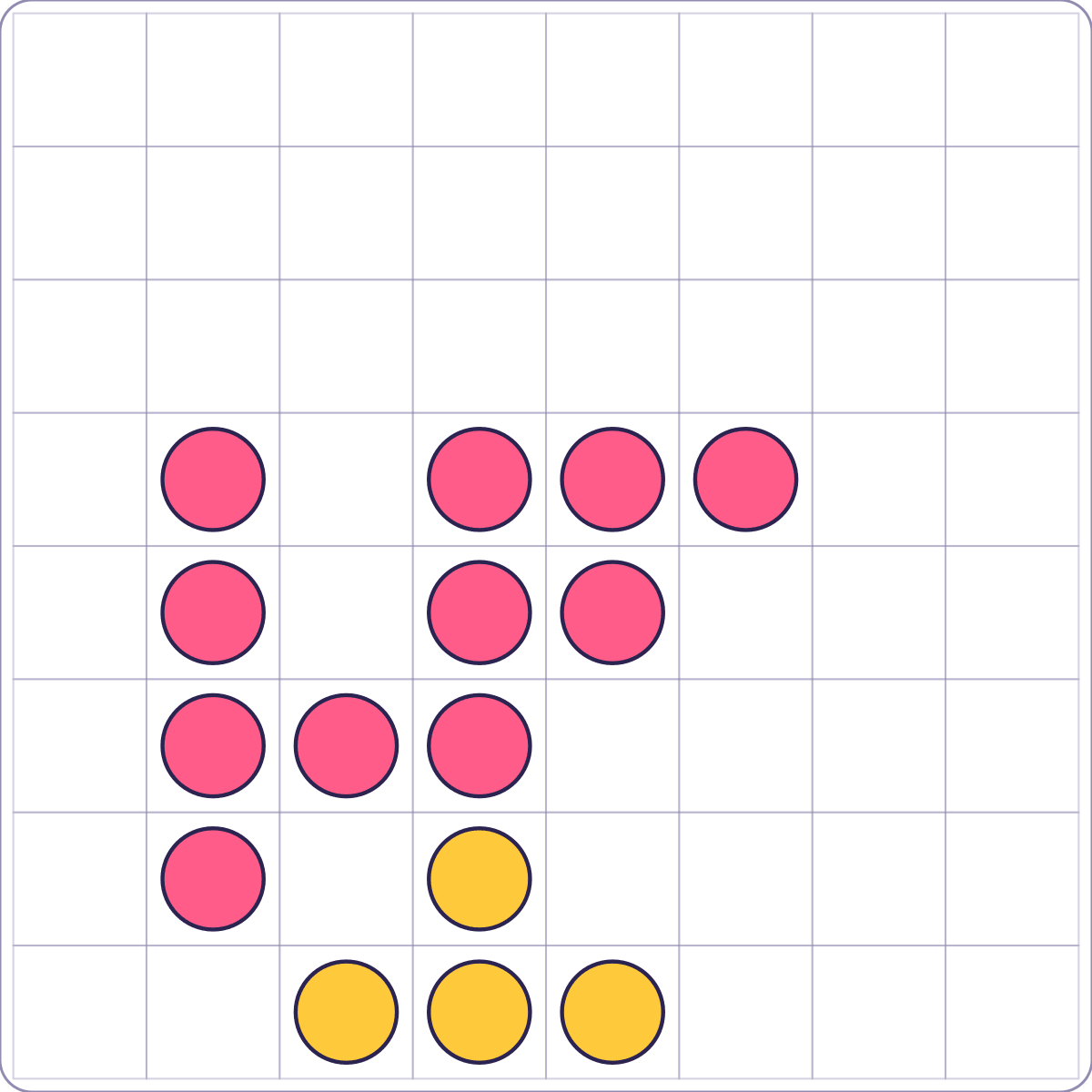
You may only play on a square nobody has taken, and only where your new disc traps something. Trapping means this: in at least one of the eight directions, your new disc and a disc you already own sit at the two ends of an unbroken line of your opponent's discs.
Three things break a trap, and all three catch people out:
- A gap. If the line has an empty square anywhere in it, nothing is trapped along that line.
- The edge. If the line runs off the board without reaching a disc of yours, nothing is trapped.
- Your own disc in the middle. The line between the two ends has to be your opponent's discs and nothing else.
A move that traps nothing in any direction is not a legal move, and this board will not let you make it.
Everything trapped turns, and nothing else
When you play, every disc in every trapped line turns over. If your disc closes lines in three directions, all three turn.
You do not get to choose. The rules are explicit that every trapped disc turns "even if it is to the player's advantage not to flip them at all". And a disc that is not in a trapped line never turns, however surrounded it looks.
You cannot decline a move you have
If you have a legal move, you must play one. There is no passing to keep a position still, and this site offers no control for it.
With no move, your turn passes
If you have no legal move at all, your turn passes and your opponent moves again. This is not a choice either — it happens to you.
It is also the rule most people are surprised by, because it means one player can take several turns in a row while the other watches. A record of the game shows the same player moving twice, with no note of a pass between: a pass is not a move, so there is nothing to record.
The game ends when neither of you can move
The game is over when neither player has a legal move. That is usually a full board, but a full board is one way a game ends rather than the definition of the end — a game can finish with empty squares still on it, when nobody can legally use them.
Counting up
Whoever has more discs on the board wins. An equal count is a draw.
The score is counted slightly differently from the discs, and the number you see at the end reflects it: the winner is credited with their own discs plus every empty square, and the loser with their discs. A draw is recorded as 32–32. That is the tournament rule, and it is why a game that ended early can still be scored out of 64.
What the rulebook fixes
| What | The rule here | Source |
|---|---|---|
| The opening | Four discs on the centre squares — pink on d5 and e4, yellow on d4 and e5 | USOA |
| The board | Eight squares by eight | USOA 1.1 |
| Who moves first | Pink, the side the rulebooks call Black | USOA 3.4 |
| A legal move you would rather not make | You must make it; with no legal move at all, your turn passes | USOA 3.7 |
| The final count | Empty squares go to the winner; a draw is recorded 32–32 | WOC IV.8 |
Commonly got wrong
"Can I pass if I do not like my options?"
No. If you have a legal move you must play it, even when every one of them hurts. Passing only happens to a player with nothing at all to play.
"Do I choose which discs to turn?"
No. Every disc in every trapped line turns, in every direction, every time. This is the rule that decides most beginners' games: a move that looks small can turn three lines at once.
"Is a line with a gap in it still trapped?"
No. The line between your two discs has to be unbroken and entirely your opponent's. An empty square anywhere in it, or one of your own discs, and that direction traps nothing — though another direction from the same move may still trap plenty.
"The board is not full — why has the game ended?"
Because neither player had a legal move. A full board is the usual ending, not the rule.
Sources
The rules on this page follow the published ones rather than house custom:
- USOA Official Rules of Othello — the board and the opening position, what traps and what turns, the forced move, the forced pass, and how a game ends.
- World Othello Championship rule `WOC IV.8` — how a finished game is scored, including the empty squares and the 32–32 draw.
Othello is a registered trademark of its owner. It is named here only to identify the published rulebooks these rules follow; this game is Reversi, and this site is not affiliated with or endorsed by the trademark holder.
Updated
Go deeper
Good to know
- Players
- 2
- How long a game takes
- 10–15 min
- Boards
- 8×8