Nine Men's Morris is a two-player game on a board of twenty-four points. Each player has nine pieces: first you place them, then slide them along the lines. Three of yours on a line make a mill and take one opponent's piece. Reduce them to two or leave them no move and you win, in ten to twenty minutes.
Your first game
- The board is twenty-four points — three squares one inside another, joined by a line through the middle of each side. A piece stands on a point, and it may only ever travel along a drawn line.
- You have nine pieces each. Pink goes first.
- First you place. Take turns putting one piece on any empty point, until all eighteen are on the board.
- Then you slide. With nothing left in hand, a move is one of your pieces, along one line, to an empty point next to it.
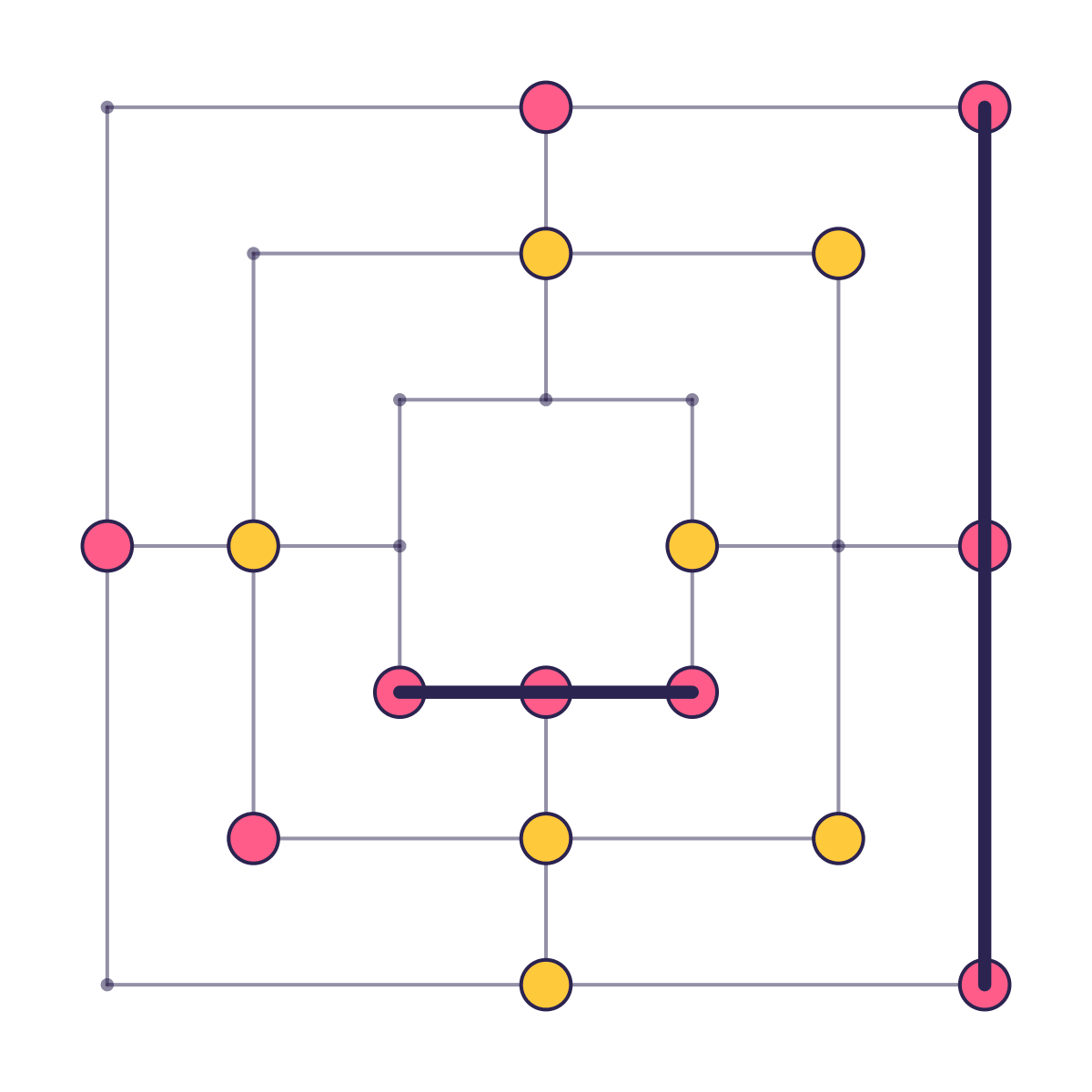
- Either way, the thing you are trying to build is a mill: three of your pieces on one line.
- Every time you make a mill, you take one of your opponent's pieces off the board, straight away, before play passes.
- You win when your opponent is down to two pieces, or has no legal move.
The rules
The board
Twenty-four points, arranged as three concentric squares joined by four lines, one through the middle of each side. There are thirty-two connections and sixteen lines of three, and those sixteen are the only lines that make a mill.
There are no diagonals, the corners of one square do not join to the corners of another, and the centre of the board is not a point at all.
Nine Men's Morris is for exactly two players.
Nine pieces, and a phase that changes what a move is
Each player has nine pieces, and the phase you are in is decided by where your pieces are — not by a clock, and not by what your opponent is doing. The two of you can be in different phases at once.
While you have pieces in hand, your move is to place one on any empty point.
When your hand is empty, your move is to slide one of your own pieces along a line to an empty point next to it. You may not jump over a piece and you may not travel two points in one move.
On the standard board only: when you are down to exactly three pieces and have none in hand, you may move a piece to any empty point on the board, next to it or not. This is called flying, and it is the losing player's last chance.
Three on a line is a mill
When a placement or a slide puts three of your pieces on one of the sixteen lines, you have a mill, and you must take one of your opponent's pieces off the board before play passes. It is not optional and it is not deferred.
Which piece you may take:
- Not a piece that is part of a mill — unless every piece your opponent has left is in one, in which case you may take any of them.
- Any other piece, anywhere on the board, whether or not it is next to anything of yours.
A piece you take is out of the game. It does not go back into its owner's hand, and it cannot be placed again.
Two rules people expect and which this board does not have:
- One move that completes two mills at once still takes exactly one piece. Not two.
- Re-forming a mill you have made before counts again. Slide a piece out of a mill and back in next turn and you take another piece, every time, for as long as your opponent lets you.
Losing
You lose if either of these becomes true of you:
- You are down to two pieces, with none left in hand.
- It is your turn and you have no legal move — every piece of yours is blocked in.
The first of those only counts once your hand is empty. Passing through two pieces on the board while you still have seven to place is an ordinary opening, not a defeat.
Drawing
A game is drawn if the same position comes up for the third time with the same player to move. The position means the twenty-four points and whose turn it is, and nothing else.
That is the only draw rule here. There is no move limit and no no-capture limit: this board is finite, so a game that never ends must repeat itself eventually, and the repetition rule catches it.
Two boards, two ladders
This site runs two versions, and they differ in exactly one rule:
- Standard — a player down to three pieces may fly.
- No flying — they may not, and must keep sliding along the lines like anybody else.
They are separate games here: separate tables, separate ratings, separate rankings. A rating in one says nothing about the other.
The two boards, side by side
| Standard | No flying | |
|---|---|---|
| Pieces each | 9 | 9 |
| Placing, then sliding | Yes | Yes |
| Down to three pieces | May move to any empty point | Must keep sliding along a line |
| Rated | On its own ladder | On its own ladder |
Commonly got wrong
"I made two mills with one move. Do I take two pieces?"
No. One move, one piece, however many mills it completed.
"I have made that mill before. Does it still count?"
Yes, every time. Sliding a piece out of a mill and back in again is a real tactic — an open mill — and it takes a piece each turn. There is no rule here against re-forming a mill you have formed before.
"Can I take a piece that is in a mill?"
Not while they have a piece that is not. If every piece they have left is in a mill, you may take any of them.
"Can I place a piece and take one in the same turn?"
That is exactly what happens — the mill is made by the placement, and the capture is part of the same turn. You will be asked for it before your opponent moves.
"My opponent is down to three pieces and jumped across the board."
That is flying, and it is in the standard game. If you would rather it were not, the No flying board is the same game without it.
"Is there a rule about too many moves without a capture?"
No. That is a chess rule and it has no counterpart here; it was in an early draft of this game and was taken out for exactly that reason. Threefold repetition is the only way a game is drawn.
Sources
Nine Men's Morris is ancient and has no single published rulebook that everybody follows. The variations are real and well known — whether a player reduced to three pieces may fly, whether a mill may be re-formed, whether two mills take two pieces — so naming one authority would be inventing one.
What is written above is exactly what this site's server enforces, and the three places the game is genuinely played differently elsewhere are the three this page states plainly: flying is a choice you make by picking a board, re-forming a mill counts every time, and one move takes one piece.
The game is played in Poland as młynek, in Germany as Mühle, and in English-speaking countries as Nine Men's Morris or mills.
Updated
Go deeper
Good to know
- Players
- 2
- How long a game takes
- 10–20 min
- Boards
- Standard · No flying