Put your first pieces where they have the most ways to move: the four points where the middle square meets the connecting lines, each with four neighbours, then the midpoints with three. Corners have two and can wait. Block a line of two before you build one, and aim for a piece that can swing between two mills.
Which points have the most neighbours?
The board is three squares joined by four lines, 24 points in all, and a mill is three of your pieces on any of its 16 lines (the board). Every point lies on exactly two lines — a corner on two sides of its square, a midpoint on its side and its connecting line — so no point is on more lines than another. What differs is how many neighbours a point has, which is how many ways a piece there can move once the placing is over: 4 at the four points where the middle square meets the connecting lines, 3 at the other 8 midpoints, and 2 at each of the 12 corners.
That is the opening in one sentence. A piece with four neighbours is hard to block and quick to join a line in either direction; a piece with two is the easiest thing on the board to shut in.
Why do the corners wait?
A corner touches two points only. A piece there can be shut in by two of your opponent's pieces, and in the sliding phase a piece that cannot move is a piece that does not count — a player with no legal move has lost (the rule). A corner is also the end of two lines rather than the middle of any, so a piece placed there early is a promise about two specific lines, made before you know which lines the game will be about.
Corners are for finishing, not starting: when a side of a square already holds two of your pieces, the corner that completes it is exactly the point to take.
Should I block or build first?
During placing, every piece goes down before any piece slides (the phases), and two of your opponent's pieces on one line with the third point empty is a mill on their next turn unless you fill it. Fill it. Your own line of two can wait a move; theirs cannot, and the piece you spend blocking is still a piece on the board, usually on a point you wanted anyway.
The exception is the move that both blocks and threatens — a piece that closes their line and makes two on a line of yours. Those are the moves to look for, and the four-neighbour points offer them most often because they sit on a side and a connecting line at once.
What is a double mill?
A mill formed once takes a piece once. What wins games is a piece that can slide out of one mill and straight into another, then back again next turn: every move it makes forms a mill, and every mill takes a piece (the rule). Players call it a running or double mill, and once one is set up the opponent loses a piece every other move until they can break it — which, with the running piece's two lines both anchored by your other pieces, they often cannot.
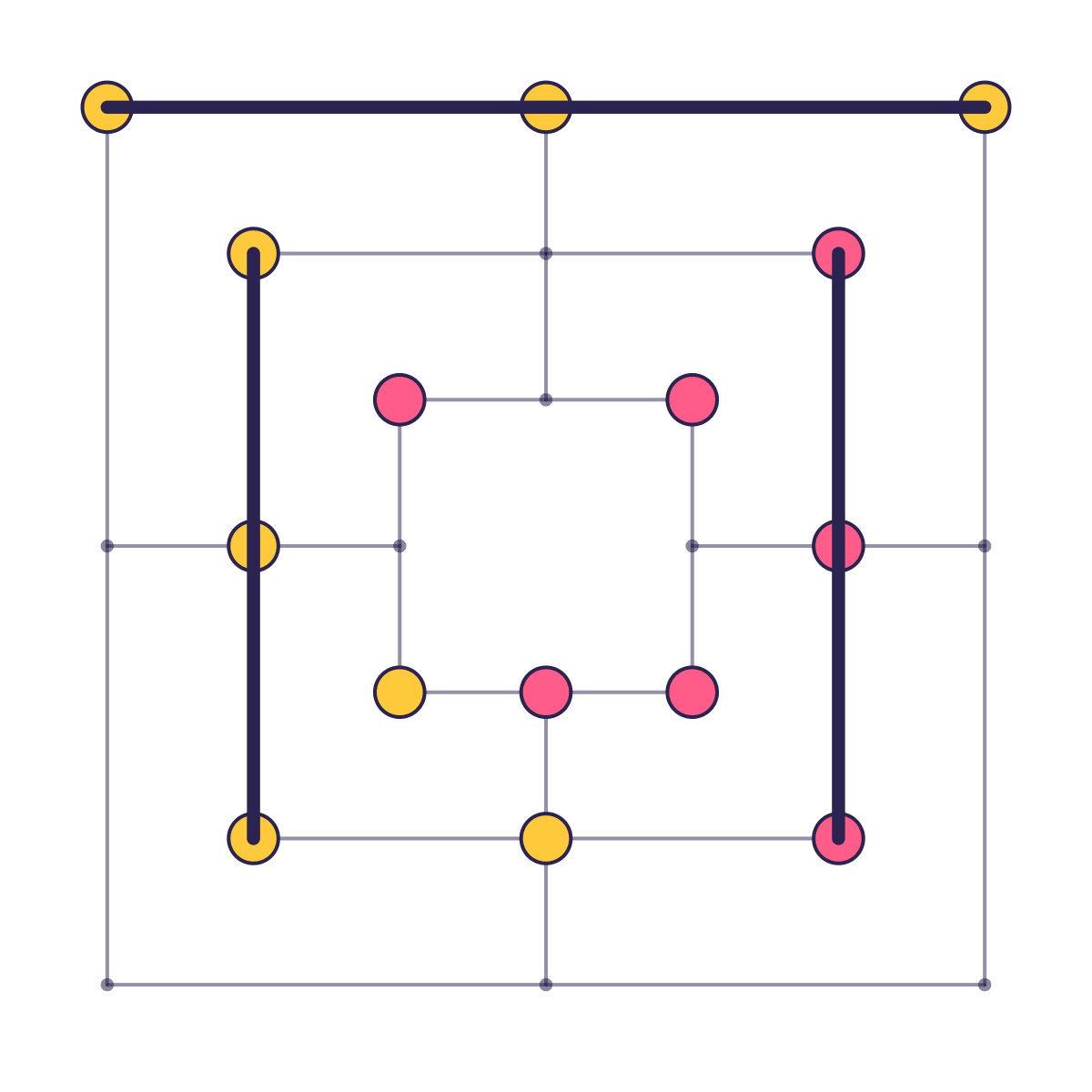
Build towards it from the placing phase: two pieces on one line and two on a neighbouring line, with a free point between them that belongs to both, is the shape.
What about the board without flying?
On the standard board a player down to three pieces may jump to any empty point, so a shut-in piece is never quite shut in and a big lead can evaporate in the endgame. On the No flying board it cannot: blocking wins, and a player who cannot move has lost. The two boards are rated separately here (the table), and the opening advice above is the same on both — the difference is how much a well-placed piece is worth at the end.
Sources
- Nine men's morris — Wikipedia: the board, the phases and the flying rule.
- Nine Men's Morris strategy — playabstractgames.com: the placing phase and the double mill for players.
- Nine Men's Morris — tips and tricks, jmmgc.com: blocking, mobility and corners.
- The rules of nine men's morris on this site, which every position on this page was played by, with its own sources.
Updated