Dots is a two-player pencil game on a grid of crossings, ten by ten here. Players take turns placing a dot on an empty crossing. When your dots close a chain around your opponent's, the ground inside is yours and out of play. Whoever has surrounded more when both players end wins. A game runs ten to twenty minutes.
Your first game
- The board is a grid of ten by ten intersections — the crossings of the lines, not the squares between them. Pink plays first.
- On your turn you place one dot on any free intersection. That is the whole move: there is nothing to choose but where.
- You take your opponent's dots by surrounding them. Build a closed chain of your own dots around one or more of theirs, and everything inside the chain becomes your ground.
- The score is the number of your opponent's dots you have surrounded. When the game ends, the higher score wins.
The rules
The board, and what a move is
The board has ten intersections a side. A dot goes on an intersection, never in a square, and the lines are only there to help you see the grid.
A move places one dot on an intersection that is free: nothing on it, and not inside anybody's surrounded ground. Anything else is refused — a taken intersection, a point inside a base, a point off the board.
You may not pass. On this site you have 60 seconds for each move.
A closed chain takes what it surrounds
When the dot you place completes a chain of your own dots that encloses at least one intersection, everything inside becomes your ground and stays yours.
A chain is a run of your dots where each is next to the next — horizontally, vertically or diagonally — which begins and ends on the same dot. Four of your dots on the four sides of a single intersection are a closed chain around it, and that is the smallest capture in the game.
What counts as inside is the smallest area your chain can be said to enclose. An intersection is inside if it cannot reach the edge of the board by steps up, down, left and right without crossing one of your dots. Note the difference, because it is the part that surprises people: your chain holds together diagonally, but an escape only runs straight. A diagonal gap in your ring is not a leak.
No dot of the chain itself is ever inside its own enclosure.
A ring around nothing is not a base
An enclosure that holds none of your opponent's dots takes nothing. Nothing is drawn, nothing is scored, and every intersection inside it stays free to play on — by either of you.
Two words are worth keeping apart here, because the rest of this page rests on the difference. A chain is a loop of your dots — a closed one is what this page also calls a ring, and they are the same thing. A base is ground such a chain has actually taken. Every base has a chain around it, and a chain around empty ground is not a base and never was one.
That rule is what makes the game a fight rather than a race, and its consequence is the next one.
A dot played into a ring is taken by it
If you place a dot inside a chain your opponent has already closed, and that dot does not itself enclose something of theirs, it is captured the moment you play it. Your own move is what makes their base.
This is not playing inside a base, which nobody may ever do. That ground had never been taken: the chain closed around nothing, so there was nothing to take and the middle stayed open like any other free intersection. Your dot is what turns it into a base — and once it is one, nobody plays there again.
This is the published rule, not ours. Why the middle was free is zagram: "okrążenie musi zawierać przynajmniej jedną kropkę przeciwnika, która nie została wcześniej okrążona" — an enclosure must hold an opponent's dot that was not already surrounded, and without one there is no enclosure at all. What happens to a dot played into such an empty one is Wikipedia, in as many words: "If one places a dot into empty area surrounded by the opponent and cannot immediately use it to surround, then this dot can be captured by the opponent."
The order is exactly this, and it is the only thing that lets you play into enemy ground at all: the mover's enclosures are worked out first. If your move surrounds something of theirs, your dot lives and your capture stands. Only if it surrounds nothing does their ring get to take it.
What is surrounded is out of the game
Ground inside a base is finished. Neither of you may place a dot on it, ever, and it does not matter whose base it is — you may not play inside your own either.
A chain with nothing inside it is not a base, and the ground inside it is ordinary free ground. That is the rule above, and it is the only way a dot is ever played inside somebody else's chain.
A dot inside a base also stops working: it can no longer be part of any chain that surrounds anything, whoever owns it and whoever owns the ground it is standing on.
Captured dots stay on the board. Nothing is ever removed; the ground under it changes hands.
A bigger ring gives everything back
If you close a chain around a base your opponent already holds, everything inside your new base becomes yours — including what was inside theirs, and every dot they were counting there stops counting for them.
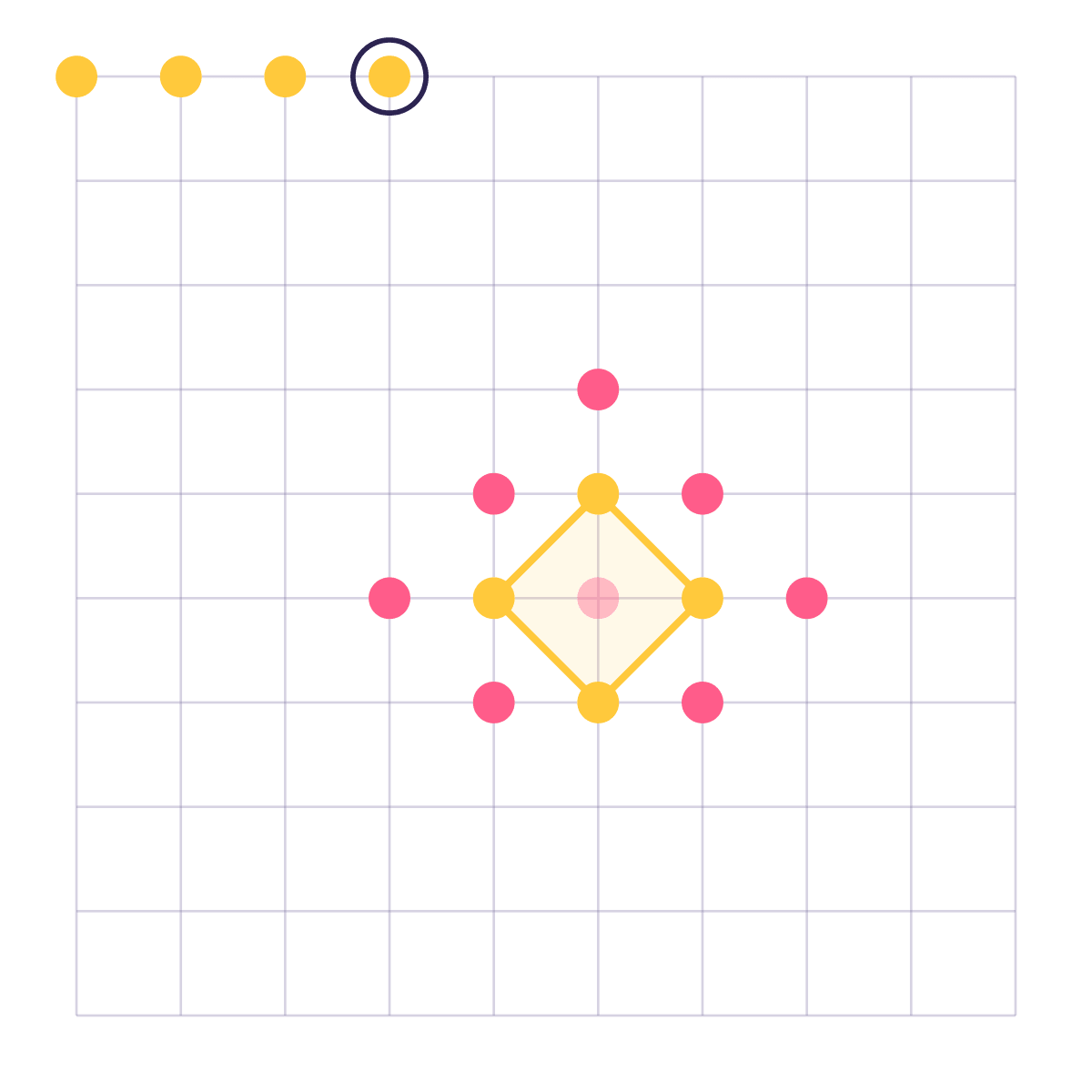
This is the comeback, and it is why a game that looks settled often is not. A base is not safe ground; it is ground that is safe until somebody puts a bigger ring around it.
Counting
Your score is the number of your opponent's dots lying inside your bases. Your own dots never count for you, no matter who surrounded them or how many of them there are.
The player with the higher score at the end wins. Equal scores are a draw.
Ending the game
Dots has no natural finish: at some point there is nothing left worth taking, and somebody has to say so. Either player may end the game on their turn.
Ending is not resigning and not offering a draw. Your position stands, and your score stands — but you make no more moves, and your opponent may go on playing alone for as long as they like, taking whatever dots of yours they can still surround. It cannot be taken back, which is why the board asks before it sends it.
The match is over when both players have ended it, or when there is no free intersection left to play on anywhere — ground inside a base does not count as free. While one player has ended and the other has not, the clock runs against the one still playing, at the usual 60 seconds a move.
Two sizes of board
| 10 × 10 | 20 × 20 | |
|---|---|---|
| Crossings | 100 | 400 |
| Where it is played | Online here, and on paper | On paper only |
| Boards on one A4 sheet | 4 | 1 |
| A game runs | About ten minutes | Three quarters of an hour or more |
Commonly got wrong
"I put a ring round an empty space and nothing happened."
That is the rule working. An enclosure with none of your opponent's dots in it is not a base — it takes nothing and the ground inside stays playable. See A ring around nothing is not a base above.
"My chain has a diagonal gap. Does it still hold?"
Yes. A chain connects diagonally; an escape only runs up, down, left and right. A diagonal step is enough for your ring and not enough for anything trying to get out of it.
"Can I play inside my own base?"
No. Ground inside a base is out of the game for both players, and that includes the player who took it.
"Then how can anybody play inside a ring?"
Because a ring around empty ground is not a base. Only a chain that has actually taken something makes ground that is out of play; an enclosure holding nothing takes nothing, and its middle is as free as any other intersection — until somebody steps into it and hands it over.
"Why does my score not count the dots of mine they surrounded?"
Because a score is only ever your opponent's dots inside your ground. Your own dots are worth nothing to you wherever they are — losing them costs you because they count for them.
"They ended the game — is that a draw offer?"
No. It is the opposite: they have stopped playing and you have not, so you may go on taking whatever you still can while they watch.
"Their base is huge. Is the game over?"
Not necessarily. Surround their base with a bigger ring and everything inside it, theirs and yours, becomes yours.
Sources
The rules on this page follow the published ones:
- zagram.org — Kropki, zasady gry and its English page — the reference implementation the Polish and Russian playing communities use, and the closest thing this game has to a rulebook. The move, the chain, the requirement that an enclosure hold an opponent's dot not already surrounded, the ban on playing into finished ground, the liberation of a swallowed base, the score, ending the game and the full board all come from there.
- Wikipedia — Dots (paper-and-pencil game) — the minimum enclosed area, that a player who has ended may be played around at will, and the dot played into an opponent's empty enclosure, quoted above in the source's own words.
- ~~`pointsgame/oppai-rs` — for the one rule only an implementation settles: what happens on the move that enters an enemy enclosure.~~ Corrected 2026-09-16: that case is stated by Wikipedia and the sentence is now quoted where the rule is taught. `pointsgame/oppai-rs`, the community's open engine, stands for what no published text settles: the order — the mover's enclosures resolve first, and only if the move took nothing does the opponent's enclosure get its turn.
The board size and the 60-second move clock are this site's, not theirs. The game is played in Poland as kropki.
Updated
Boards to print
Go deeper
Good to know
- Players
- 2
- How long a game takes
- 10–20 min
- Boards
- 10×10