Surround by closing a chain of your dots around your opponent's: neighbours along the grid and on the diagonals both count as links. A closed ring with an enemy dot inside takes it and the ground; a ring around empty ground takes nothing. Build from two dots outward, and when their ring is small, draw a bigger one round it.
What counts as a closed chain?
A chain is a run of your dots in which each is a neighbour of the next — and on this board a neighbour is any of the eight crossings around a dot, so a chain can step diagonally as freely as along the lines (the rule). That is the fact most first games get wrong: a diagonal gap is not a gap, and a ring that looks porous on paper is closed (the question). The smallest ring the rules accept is 4 dots, one on each side of a single crossing, on a board of 100 crossings.
When the last dot closes the chain, everything inside — enemy dots and empty ground alike — becomes your base, is drawn as yours, and is out of the game for good.
Why does a ring around nothing score nothing?
Because the score is the dots you surrounded, not the ground: a ring with no enemy dot inside it is not a base at all, and the crossings inside stay playable (the rule). The one thing an empty ring does is wait — a dot your opponent plays inside it is taken the moment it lands (the rule), so an empty ring is a fence they will not cross, not a point.
That changes what to aim at. Encircle dots, not space. A chain that swings wide around empty ground costs you as many moves as one that hugs the dot it is after, and only the second one scores.
How do chains grow?
From two dots. The first move in an area says nothing; the second, a neighbour of the first, is the start of a chain, and every dot after it is a choice between extending the chain and beginning the ring. Your opponent sees the same chain, and a dot of theirs that is being surrounded has one way out: to link outward to another of theirs before the ring closes, because a connected group needs a ring around all of it.
So the middle of a game of dots is a race between your ring and their escape, and diagonal steps are what win races: a chain that can step on the diagonal reaches round a dot in fewer moves than one that cannot, and closes where the other still has a gap.
When does a bigger ring pay?
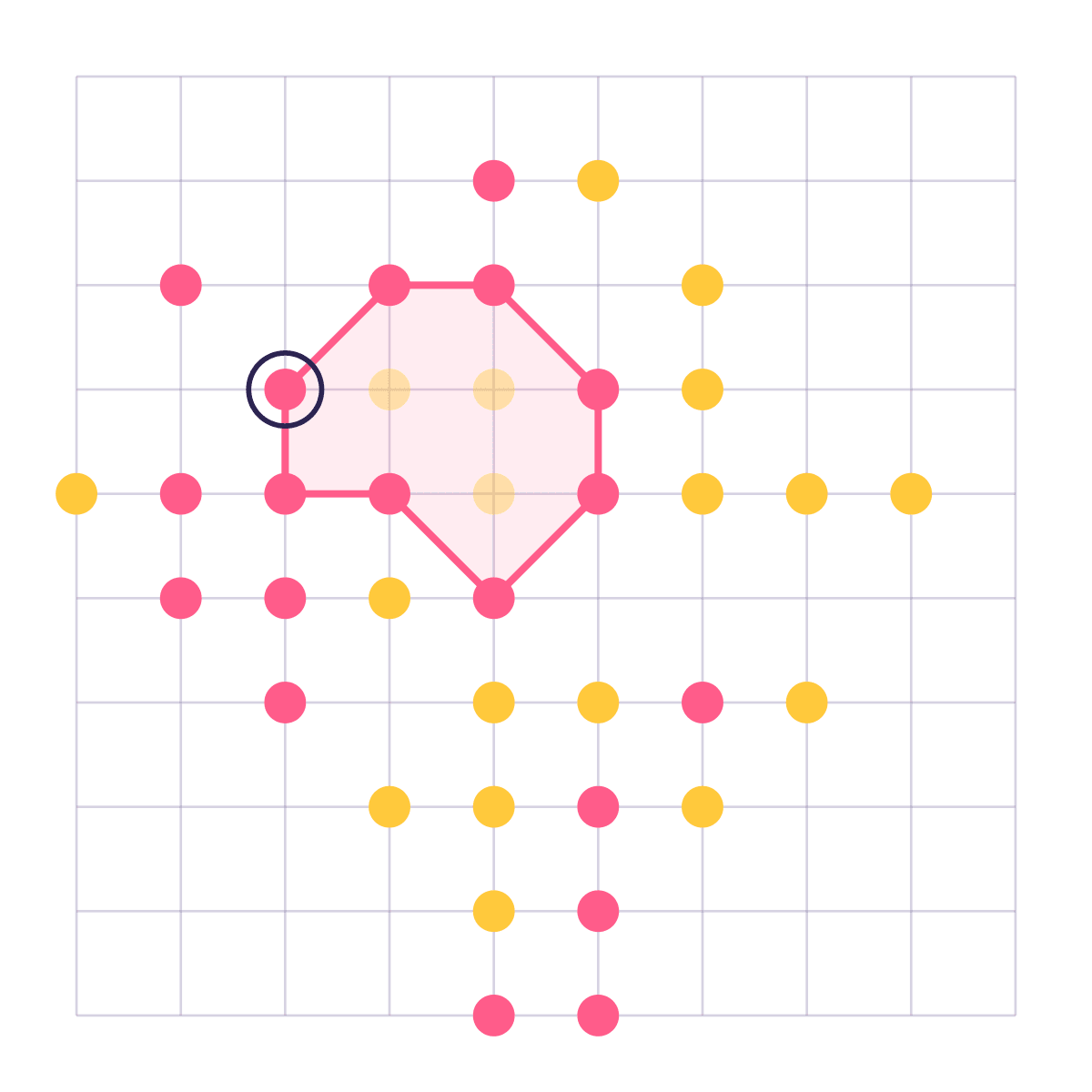
When your opponent has surrounded some of your dots, they are out of the game — but the dots of theirs that make up the ring are still on the board, and a ring of yours drawn around all of that takes their ring, gives your dots back, and counts every enemy dot inside (the rule). The bigger ring wins the exchange, always, because the smaller one is inside it.
That is why a small base is not worth defending and a large chain of theirs is worth watching: a ring that has taken one dot has spent four or more dots to do it, and those dots are now a target that cannot move.
Where should I start?
In the middle. A ring needs room on every side of the dot it is after, and so does an escape; near the edge a chain has less room to go round, and so has the dot trying to get out. Play your first dots where the board is open, keep them within reach of each other, and answer an opponent's chain before it has three dots pointing at one of yours — the third is usually the one that decides whether you will get out.
Sources
- Kropki — Wikipedia (Polish): the game, its Polish and Russian origins and the surrounding rule.
- W kropki — zasady gry, zasadygry.com: the rules as played on squared paper.
- Gra w kropki przez internet — strategie.net.pl: players on the game, in Polish.
- The rules of dots on this site, which every position on this page was played by, with its own sources.
Updated