Paper Soccer is a two-player pencil game on a pitch eight squares across and ten down, with two-square goals at each end. The ball starts in the middle; each turn you draw one line to a neighbouring point, and landing on a used point lets you kick again. Kick it into their goal to win; five to ten minutes.
Your first game
- The pitch is drawn on squared paper: eight squares across and ten down, with a goal two squares wide in the middle of each end. The ball starts on the centre point. Pink kicks first.
- A kick draws one line from the ball to a neighbouring point — up, down, sideways, or on any of the four diagonals. The ball moves along the line you drew and stops at the far end of it.
- You may never draw over a line that is already on the paper, and the walls of the pitch are lines that were there before you started.
- Now the part that makes the game. If the ball lands on a point nothing has touched yet, your turn is over. If it lands on a point that already has a line on it — one of yours, one of your opponent's, or a piece of the wall — it bounces, and you kick again.
- Win by putting the ball in the goal at the far end of the pitch — the one you are attacking. A run of bounces is how that usually happens.
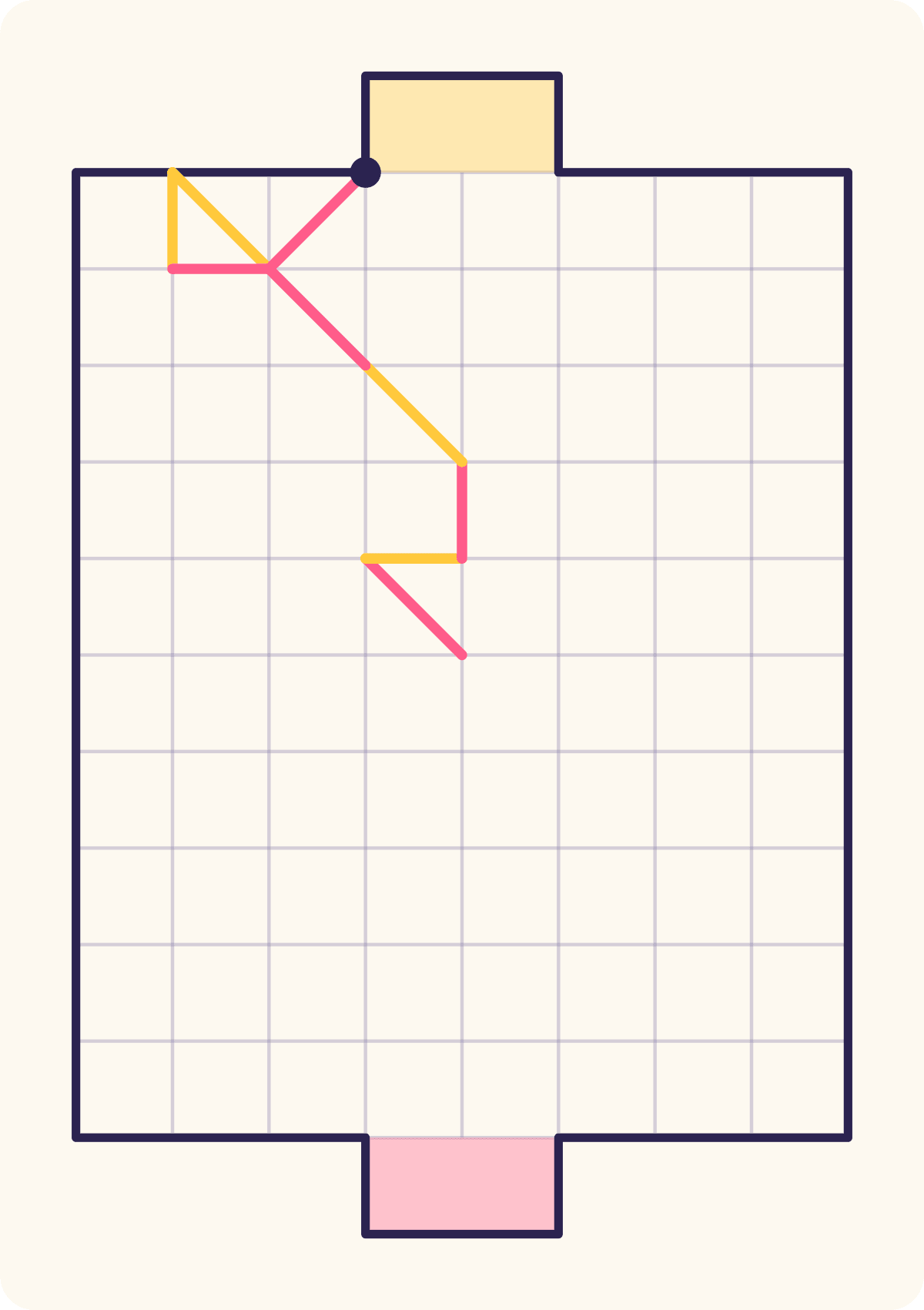
The rules
The pitch
The standard pitch is eight squares across and ten down, and the wide one is eight by twelve. Both have a goal two squares wide in the middle of each end wall. They are separate games here, with separate ratings and separate tables, and everything on this page is true of both.
The ball sits on the corners of the squares, not inside them, and the lines you draw run from corner to corner.
The four walls are drawn before the game starts, and they are lines like any other: you cannot draw over them, and a ball that reaches one has landed on a point with a line already on it. The only gaps in the walls are the two goals.
A kick is one line
On your turn you draw exactly one line, from the point the ball is on to one of its eight neighbours — north, south, east, west, or any of the four diagonals — and the ball moves to the far end of it.
Two things make a kick illegal, and the board will not offer either:
- A line that is already drawn. Including the walls, and including a line your opponent drew. You may cross a line, but you may not repeat one.
- A line that would leave the pitch, anywhere but through a goal.
You cannot pass, and there is no move that is not a kick.
Landing on a fresh point ends your turn
If every other line out of the point you landed on is still free — all seven of them — your turn is over and your opponent kicks next.
Landing on a used point gives you another kick
If anything at all already touches the point you landed on, you kick again immediately, from there, and you go on kicking until you come to rest somewhere untouched.
This is the whole tactical game. Your own lines are a springboard as well as an obstacle, a wall point is never a fresh point — which is why the edge of the pitch always bounces — and a player who has left a trail down the middle has left a road for their opponent as well as for themselves.
The ball in a goal ends the match
The ball in a goal wins the match for the player attacking that goal, whoever kicked it in. An own goal is a real way to lose here, and in a long bounce it is a real danger: you are kicking over and over without your opponent getting a say, and the goal behind you is as open as the one in front.
A ball kicked somewhere it cannot leave loses
If the ball lands on a point where every line has already been drawn, the match ends and the player who kicked it there has lost.
This is not the same as running out of moves on your turn: it cannot happen to you while you are waiting. The board never lets you kick into a dead end without knowing, because the dead end is the end of the line you are drawing.
Every match has a winner
Paper soccer here produces no draws at all. Every match ends with the ball in a goal or with the ball somewhere it cannot leave, and both of those name a winner.
The two pitches
| Standard | Wide pitch | |
|---|---|---|
| Squares | 8 across, 10 down | 8 across, 12 down |
| Goal | 2 squares wide | 2 squares wide |
| One square on the printed sheet | 16.5 mm | 14.5 mm |
| Rated | On its own ladder | On its own ladder |
Commonly got wrong
"Can I draw back along the line I just drew?"
No. That line exists now, and a line may only be drawn once. It is why the shortest bounce takes three kicks and not two — the ball has to come back to a used point by a different route.
"Whose goal is whose?"
Look at the colours: each goal is shaded in the colour of the player who defends it, so the goal you are attacking is the one in your opponent's colour, at the far end. Which end is which is fixed when the match starts and never changes.
"I put the ball in my own goal — surely that does not count?"
It counts. The rule is about which goal the ball entered, not about who kicked it. In the middle of a five-kick bounce this is easier to do than it sounds.
"Why did I keep moving when I hit the edge?"
Because the wall is a line, so the point you landed on was not untouched. Bouncing off the edge is the same rule as bouncing off your own trail.
"Do I lose if I cannot move?"
In practice the question never comes up on your turn: you lose at the moment you kick the ball onto a point with nothing left, which is your own move and not a position you were handed.
Sources
Paper soccer is a playground game and has no governing body and no single published rulebook. Different notebooks have played it differently for decades, and saying otherwise would be inventing an authority.
So what is written above is not a summary of somebody's rulebook: it is exactly what this site's server does, checked against it. The two places where a pencil-and-paper game is usually vaguer than a server can be are the two this page states precisely — what counts as a bounce, and what happens to a player who kicks the ball into a dead end — and both are named where they occur rather than left to custom.
The game is played in Poland as piłkarzyki na kartce, and in English-speaking countries most often as paper soccer or paper football.
Updated
Boards to print
Go deeper
Good to know
- Players
- 2
- How long a game takes
- 5–10 min
- Boards
- Standard · Wide pitch