Paper soccer is won by the player who controls the bounces. Every kick that lands on a point a line already touches kicks again, so one turn can cross the whole pitch, and the player left with no legal kick loses. Chain your bounces, build a net before your own goal, and leave your opponent the corners.
Why does one kick become five?
A kick is one line to a neighbouring point. If that point is fresh, your turn ends. If anything already touches it — a line of yours, a line of your opponent's, or the wall — the ball bounces and you kick again from there, and you go on kicking until you stop somewhere untouched (the rule). The wall counts as a line, so every point on the edge of the pitch is a bounce waiting to happen, and so is every point either of you has ever kicked through.
That is the whole engine of the game. In the opening the pitch is empty and a turn is one kick; by the middle of the game the centre is a web of lines and a single turn can run from your own half to their goal, bouncing off point after point. The player who sees the longer chain wins the exchange, and most of paper soccer is seeing chains a move before your opponent does.
Two habits make chains easier to see. Read the board from the ball outwards, not from the goal backwards: at each point ask whether it is used, and if it is, which of its eight neighbours you can still reach — a line already drawn cannot be drawn again, and the wall is such a line (the rule). And count bounces, not distance: a used point two squares away is worth more than a fresh point one square away, because it keeps the turn.
How do I build a net in front of my goal?
Lines are permanent, and no kick may repeat one. So every line you draw near your own goal is a line your opponent can never use to get there — but it is also a bounce they can use to keep moving. A net works when its lines close routes, not just points: draw so that the free points left in front of your goal lead away from it, and let the attacker do the bouncing into places you have already chosen.
The mistake is to draw the net too early. A half-built net is a set of springboards for the attacker, and the one thing worse than an open goal is a goal with a trampoline in front of it. Draw its lines in the turns you would otherwise waste, far from the ball, and finish it in one long turn when the ball is at the other end.
Remember whose goal is whose: you attack the far one, and the ball in either goal ends the match for the player attacking it, whoever kicked it there (the rule). A long chain of bounces near your own goal is a chain that can end in your own net.
What is the corner trap?
A ball kicked to a point it cannot leave loses the match for the player who kicked it there (the rule). A corner of the pitch is the sharpest case: two of its sides are wall, kicks along the wall are lines already drawn, and the only way in is the diagonal — which is used the moment you arrive. Kicking into a corner is therefore losing on the spot, every time, and the board will show you the dead end before you draw it.
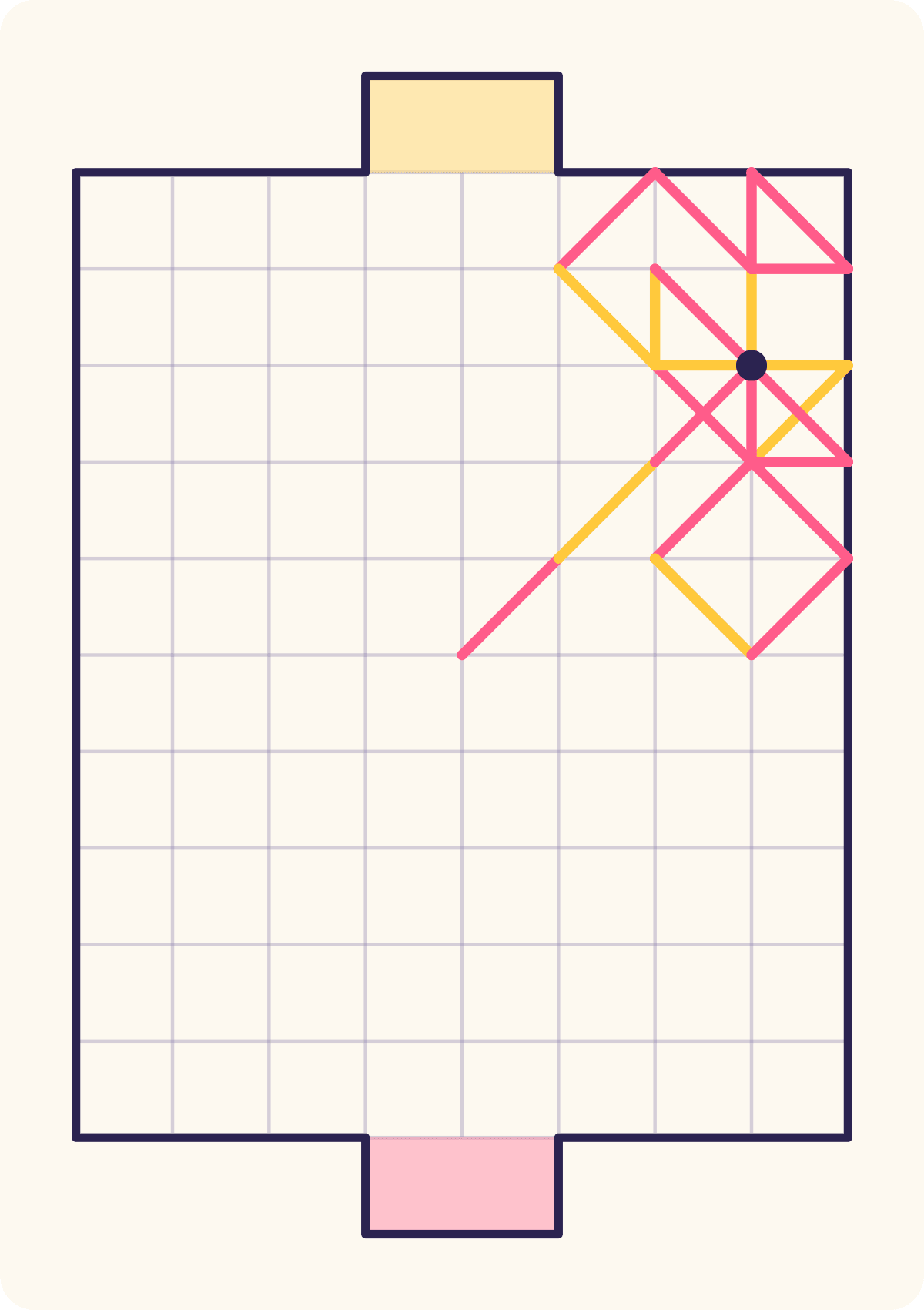
The trap is what you do with that. Every point on the edge bounces, and every edge point has at most three exits, all inward. Steer the ball so that your turn ends on a fresh point from which every one of your opponent's chains runs into the wall with the corner as the only continuation — and count the exits at every used point before you commit to a kick, because a point with one exit left is a point that decides who moves next, and a point with none is the end of the match.
What loses a game of paper soccer?
Three things, in the order beginners meet them. Kicking into your own half when a bounce towards theirs is available: every bounce you do not take is a turn you give away. Drawing lines near your own goal before you need them, which builds your opponent's chain for them. And forgetting that the wall is a line: the point where the ball first touches the edge is a bounce for whoever gets there, and the corner beyond it is the trap above.
The goal is the fourth thing and the one most people worry about most. It is two squares wide, it is at the far end, and if the three mistakes above are not being made it is where the chains lead on their own. There are no draws here: every match ends in a goal or in a dead end, and both name a winner (the rule).
Sources
- Paper soccer — Wikipedia: the game as played on squared paper, and the bounce that every strategy here rests on.
- Piłkarzyki na kartce — Wikipedia (Polish): the Polish tradition of the game, where it is a schoolroom classic.
- Paper Soccer — Braingle: the chain of bounces and the block in front of the goal, described for a first game.
- The rules of paper soccer on this site, which every position on this page was played by, with its own sources.
Updated