A corner disc can never be turned, because there is no square beyond it to trap it from, and every disc it anchors along an edge becomes safe too. Reversi is won by taking corners and by not handing them over: avoid the squares beside an empty corner, and keep more moves than your opponent.
Why can a corner disc never turn?
A disc turns when it is trapped: your opponent places a disc so that a straight, unbroken line of your discs sits between the new disc and another of theirs (the rule). To trap a disc you need a square on each side of it along some line. A corner has a square on one side only, in every direction — there is nothing beyond it — so no line through a corner can ever be closed, and a disc there is yours for the rest of the game.
That safety spreads. A disc on the edge next to your corner can be trapped only along the edge, and along the edge one side of it is the corner, which is yours. So it is safe as well, and so is the next one, as far as your discs run unbroken from the corner. Players call these stable discs, and the count of them is the count that matters at the end, because it is the count nothing can change.
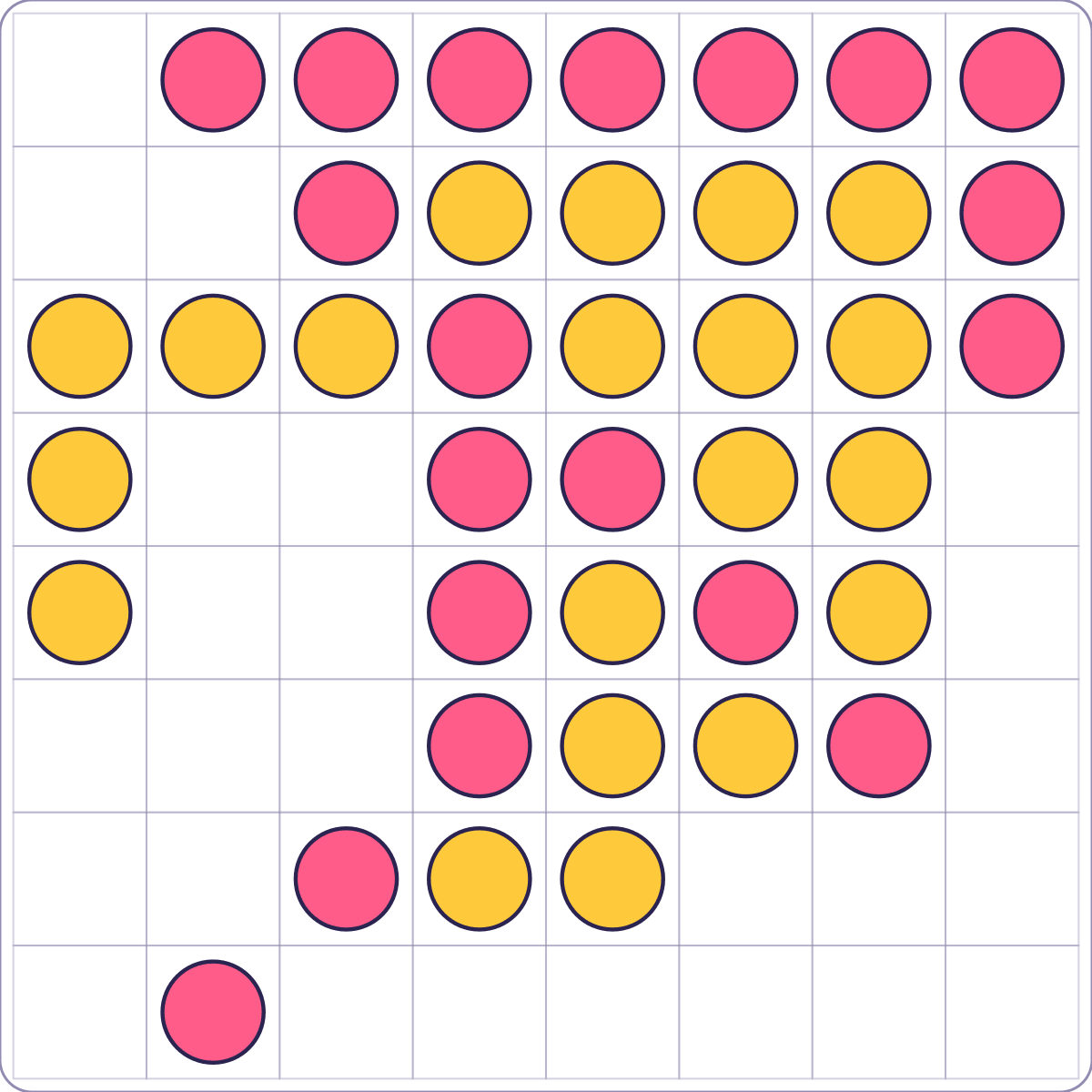
Which squares hand the corner over?
The four squares diagonally inside the corners — b2, g2, b7 and g7 — are the most dangerous squares on the board while the corner beside them is empty. A disc on one of them lies on the long diagonal that ends in the corner, and the moment your opponent can place a disc in that corner with one of theirs beyond your disc, your disc is trapped and the corner is theirs. The two squares beside each corner along the edges (a2 and b1 beside a1, and so on) do the same thing along the edge.
So the rule of thumb is a rule about waiting: do not play beside an empty corner unless you have counted that your opponent cannot reach it, and prefer any other move while you still have one. That last clause is where the second half of reversi strategy comes from.
Why are fewer discs early a good thing?
Having more discs on the board in the middle of the game usually means having more discs your opponent can reach — every disc you own on the edge of the occupied area is a disc they can trap. And the player who runs short of good moves is the one who ends up playing beside a corner, because you cannot decline a move you have (the rule): when the only legal squares left are the bad ones, you play a bad one.
The measure players use is mobility: how many legal moves each side has. Keeping your discs few and inside the occupied area gives your opponent fewer discs to trap and leaves you more choices later; flipping a long line early does the opposite. It looks like losing for most of the game and it is how games are won, because the discs are counted only once, at the end (the rule).
What should I play first?
Pink has four legal moves from the opening position, and they are the same move seen from four sides (the position): whichever you pick, the board is a rotation of the others. The choices that matter come after it — and the corner and mobility ideas above are enough to make them: take few discs, stay away from the squares beside an empty corner, and when a corner is offered, take it.
Sources
- Reversi/Strategy — Wikibooks: corners, stable discs, X- and C-squares and mobility, as the standard account.
- The strategy to winning Othello — Comte's guide, othello.nl: the case for fewer discs early, from a competitive player.
- Tips for reversi — Board Game Arena: the same ideas in a beginner's order.
- The rules of reversi on this site, which every position on this page was played by, with its own sources (USOA, WOC).
Updated