Start in the middle column. On a seven-by-six board 69 different fours can be made, and 51 of them use the middle column, against 15 for an edge column; with perfect play the first player wins from the middle and only from there. The rest of the game is about which rows your threats land on.
How many fours pass through each column?
Count every straight line of four squares the board holds — across, down and on both diagonals — and there are 69 of them (the rules page's table). Now count how many of those lines use at least one square of a given column: 51 for the middle column, 39 for either column beside it, and 15 for an edge column. A disc in the middle is a disc that can be part of more than three times as many fours as a disc at the edge, and that is the whole first-move argument in one number.
It is sharper square by square. The two middle squares of the middle column each lie on 13 of the 69 fours, the most of any square on the board; the bottom square of the middle column lies on 7; a corner square lies on 3.
Is the game really solved?
Yes, and since 1988. Victor Allis proved in his thesis, and James Allen showed independently the same year, that the first player can force a win by playing the middle column first. Start in either column beside it and the best either side can do is a draw; start in one of the four outer columns and it is the second player who can force the win. Nobody at a kitchen table plays perfectly, and a forced win from the middle is forty-one moves of not making a mistake — but the first move is the one decision in the game that is settled, and the middle column is the answer.
What are odd and even threats?
A threat is an empty square that would complete your four. What decides whether you ever get to play it is the square beneath it: a disc falls to the lowest empty square of its column (the rule), so a threat with an empty square under it is a promise, not a move. When the board fills and both players are running out of safe columns, somebody is forced to play beneath the other's threat and hands it over.
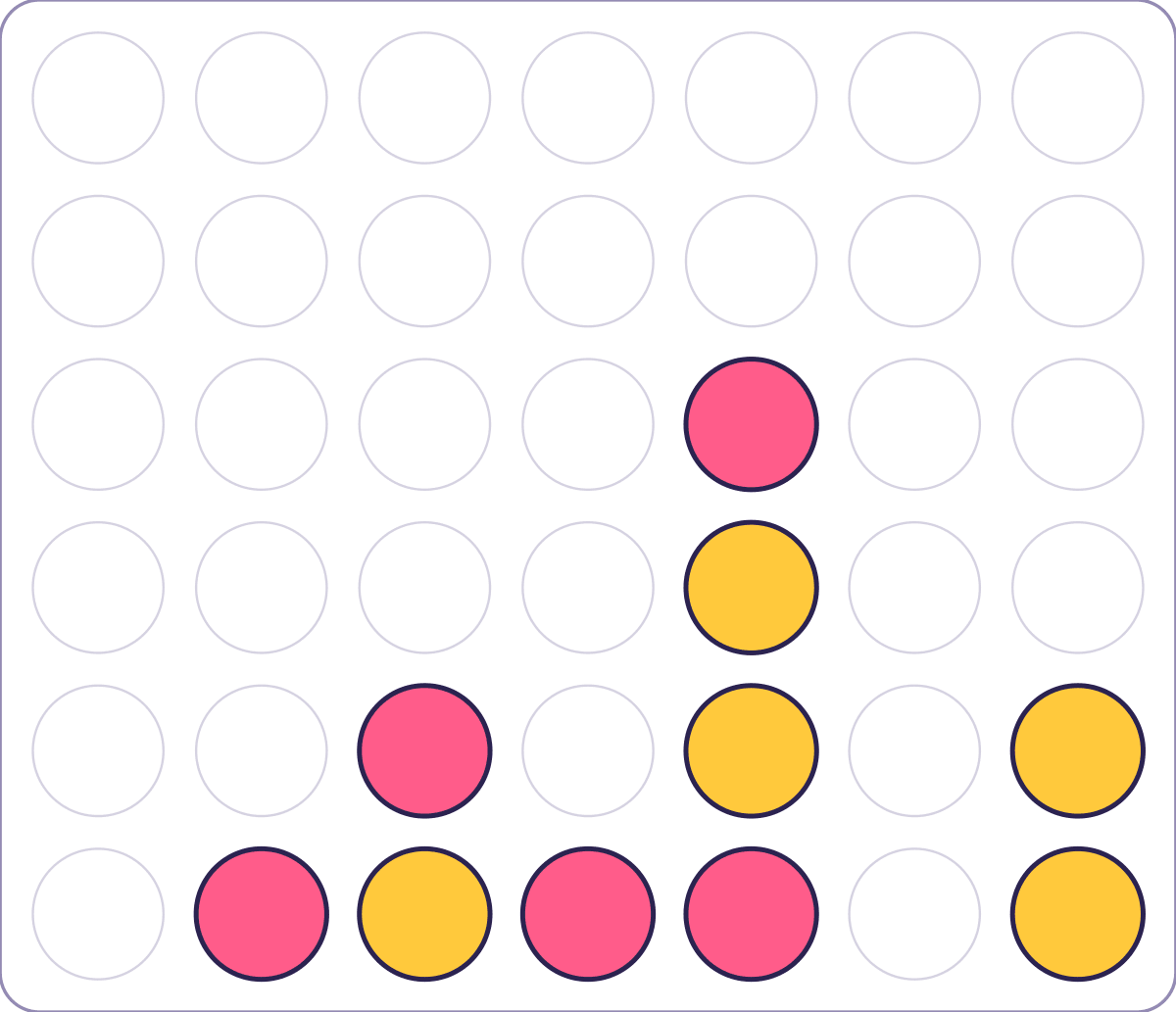
Which somebody is a matter of counting. Pink moves first and the board has 42 squares, so when every other column is full, pink fills the odd-numbered rows of the last one — the first, third and fifth from the bottom — and yellow the even ones. A pink threat on an odd row is therefore a threat pink can wait on: in the end, the square under it is yellow's to fill. A yellow threat wants an even row for the same reason.
What should I do after the first move?
Keep to the three middle columns while you can, because that is where the fours are. Block a three the moment it appears — a four wins on the spot, whatever else is happening (the rule). Before every disc, look at the square directly above the one you are about to fill: if it completes your opponent's four, you have just given them the game. And when you build a threat, build it on your row — odd if you moved first, even if you did not.
Sources
- Connect Four — Wikipedia: the solved game and the result for each first column.
- John Tromp — Connect Four: the full solution, with the value of every opening.
- Odd/even threat strategy — play4row: odd and even threats explained for players.
- The rules of four in a row on this site, which every position on this page was played by, with its own sources.
Updated