Shoot the squares of one colour of a checkerboard until you hit, then finish the ship around the hit. Every ship is at least two squares long, so it covers both colours and cannot hide from a one-colour search; that halves the squares you must try. Place your own ships apart, off the edges, without a pattern.
Why does one colour of the checkerboard find every ship?
Picture the sea as a chessboard, its 100 squares alternately dark and light — 50 of each. The fleet is five ships of 5, 4, 3, 3 and 2 squares, 17 squares in all (the fleet), and the shortest of them is two squares long. A ship two squares long covers one dark square and one light one, whichever way it lies; a longer ship covers at least one of each as well. So there is no ship in the game that a search of the dark squares alone can miss. Shoot only dark squares, and every ship will show itself within 50 shots at the very most — half the sea — where a search of every square could take all 100.
Shoot from the middle outward. A long ship has more places to lie across the middle of the sea than along its edges, so the dark squares near the centre are the ones most likely to hold something, and a shot is one square with the turn passing after it whatever it finds (the rule) — so every shot has to count.
What do I do after a hit?
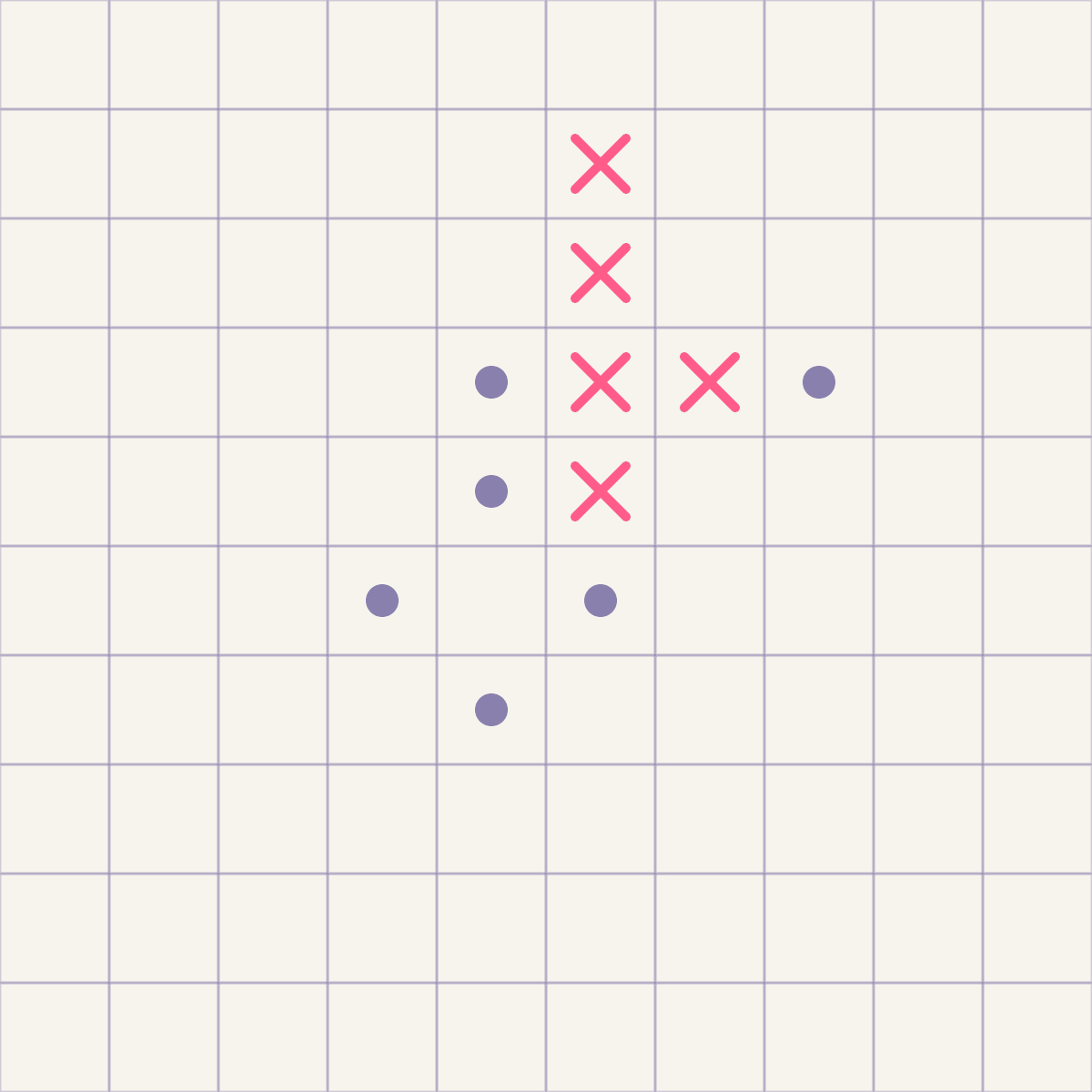
Stop hunting and start targeting. A hit tells you a ship lies through that square in one of two directions, so shoot the four squares around it until a second hit shows the line, then follow the line until the ship goes down — every square of it struck sinks it, and only then is the whole ship shown (the rule). Then go back to the dark squares where you left off.
Two things trip people up here. On this site a hit does not give you another shot: the turn passes after every shot, hit or miss, so targeting takes as many turns as it takes squares (the question). And ships may touch, so a second hit beside the first may belong to a different ship — when the squares beyond it miss, try the other direction from your first hit before you conclude anything.
How many shots does it take?
Nick Berry simulated this in 2011, on the same ten-by-ten sea and the same fleet of 17 squares, playing millions of games each way. Shooting at random, the median game needs 97 shots to sink everything — nearly every square. Hunting anywhere and then targeting around each hit brings the median to about 65. Hunting on one colour only brings it to 64: the parity trick saves fewer shots than it seems, because most of the saving was already in the targeting. Weighing every square by how many ways a remaining ship could still lie across it — the best known strategy — brings the median to about 42.
The order of those numbers is the whole lesson. Targeting after a hit is worth more than anything else you can do; the checkerboard is a small, free improvement on top; and the rest is counting.
Where should I put my own ships?
Wherever the search above would take longest to find them, which is not where people put them. Ships along the edges and in the corners feel hidden and are the first thing a good opponent checks once the middle is clear. Ships that touch are found together: sinking one of them tells the opponent where to look for the next. The rules here allow touching (the question); the advice is not to. And do not mirror, cluster or repeat a layout you have used before — a pattern is a thing a search can exploit, and the search that cannot be exploited is a layout without one.
Sources
- Battleship — DataGenetics: Nick Berry's simulations, and the median shot counts quoted above.
- Battleship: examining edge and adjacency placements — Yale CSEC: what edge and touching placements do to a game.
- Battleship strategy — Geeky Hobbies: the parity and target strategies for players.
- The rules of sea battle on this site, which every position on this page was played by, with its own sources.
Updated